Custom Pipe Fabrication for Industrial Vacuum & Pneumatic Conveying
Material selection, custom tubing dimensions, specialty elbows, fabricated fittings, and connection options for industrial vacuum, dust collection, and pneumatic conveying systems.
Custom Industrial Vacuum Tubing & Piping Solutions
Industrial vacuum and pneumatic conveying installations often require more than standard straight tubing and off-the-shelf fittings. Equipment layouts, available installation space, conveyed materials, and connection requirements can make custom pipe fabrication an important consideration during system design or replacement.
Vacuum-Tubing.com, operated by Processing Equipment Inc., supplies industrial vacuum tubing, pipe fittings, and related components. We can assist customers in reviewing requirements for custom tubing configurations, specialty bends, reducers, branch connections, and compatible joining methods, subject to product availability and fabrication feasibility.
Proper component selection can help reduce installation modifications, avoid unnecessary transitions, and support reliable operation. The best solution depends on the application, material being conveyed, operating conditions, and required dimensions.
Custom Pipe Fabrication & Component Options
Custom fabrication requirements may involve nonstandard dimensions, specific connection configurations, or piping components that must fit an existing industrial system. Available options depend on the requested specifications and manufacturing capabilities.
Custom Tubing & Pipe Sections
- Specified outside diameters
- Wall thickness or material gauge
- Custom section lengths
- Material selection
- Straight or other specified end configurations
Custom Elbows & Bends
- Specified bend angles
- Short, standard, or long radii
- Centerline radius requirements
- Specified tangent lengths
- Custom dimensional requirements
Branch & Transition Fittings
- Branch connections
- Reducers and transitions
- Custom outlet dimensions
- Connection-angle requirements
- Application-specific layouts
Connection Requirements
- Compression couplings
- Slip couplings
- Expanded-end connections
- Welded or specified mechanical joints
- Compatible adapters and fittings
For standard components, review our Industrial Vacuum Tubing , Vacuum Elbows & Bends , and Branch Fittings .
Choosing Materials for Custom Vacuum Piping
Material selection affects corrosion resistance, component weight, joining methods, fabrication requirements, and maintenance considerations. No single material is appropriate for every industrial vacuum or conveying application.
| Material | Key Considerations | Typical Applications |
|---|---|---|
| Carbon Steel | Durable and widely used; corrosion protection may be necessary. | General industrial vacuum and material handling piping. |
| Galvanized Steel | Zinc coating provides some atmospheric corrosion protection. Suitability depends on exposure and service. | Industrial vacuum and dust collection systems. |
| 304 Stainless Steel | Good general corrosion resistance. Compatibility must be assessed for the conveyed material and environment. | Selected industrial process, vacuum, and conveying applications. |
| Aluminum | Lightweight, with different corrosion, wear, and joining characteristics than steel. | Weight-sensitive and compatible industrial vacuum installations. |
Materials, grades, and wall thicknesses should be confirmed before ordering. Specialized alloys or other material options may be reviewed for particular applications.
Custom Elbows, Centerline Radius & Directional Changes
Elbows and bends are important components in industrial vacuum tubing and pneumatic conveying systems because they change the direction of airflow and conveyed materials.
Selecting the appropriate bend radius requires consideration of the conveying velocity, material characteristics, available space, pressure loss, and potential wear.
Short Radius Elbows
Short radius elbows provide compact directional changes where equipment clearances or installation space are limited.
Standard Radius Elbows
Standard radius elbows offer an intermediate bend geometry for general industrial vacuum piping layouts.
Long Radius Bends
Long radius bends provide more gradual directional changes and may help reduce concentrated material impact in suitable applications.
Custom Bend Requirements
Custom angles, centerline radii, tangent lengths, materials, and end configurations may be evaluated according to the required design.
Important: A longer radius is not automatically the best choice for every conveying application. System layout, flow conditions, product behavior, and abrasion characteristics should determine the final selection.
Abrasion Resistance, Wear Protection & Surface Treatment Options
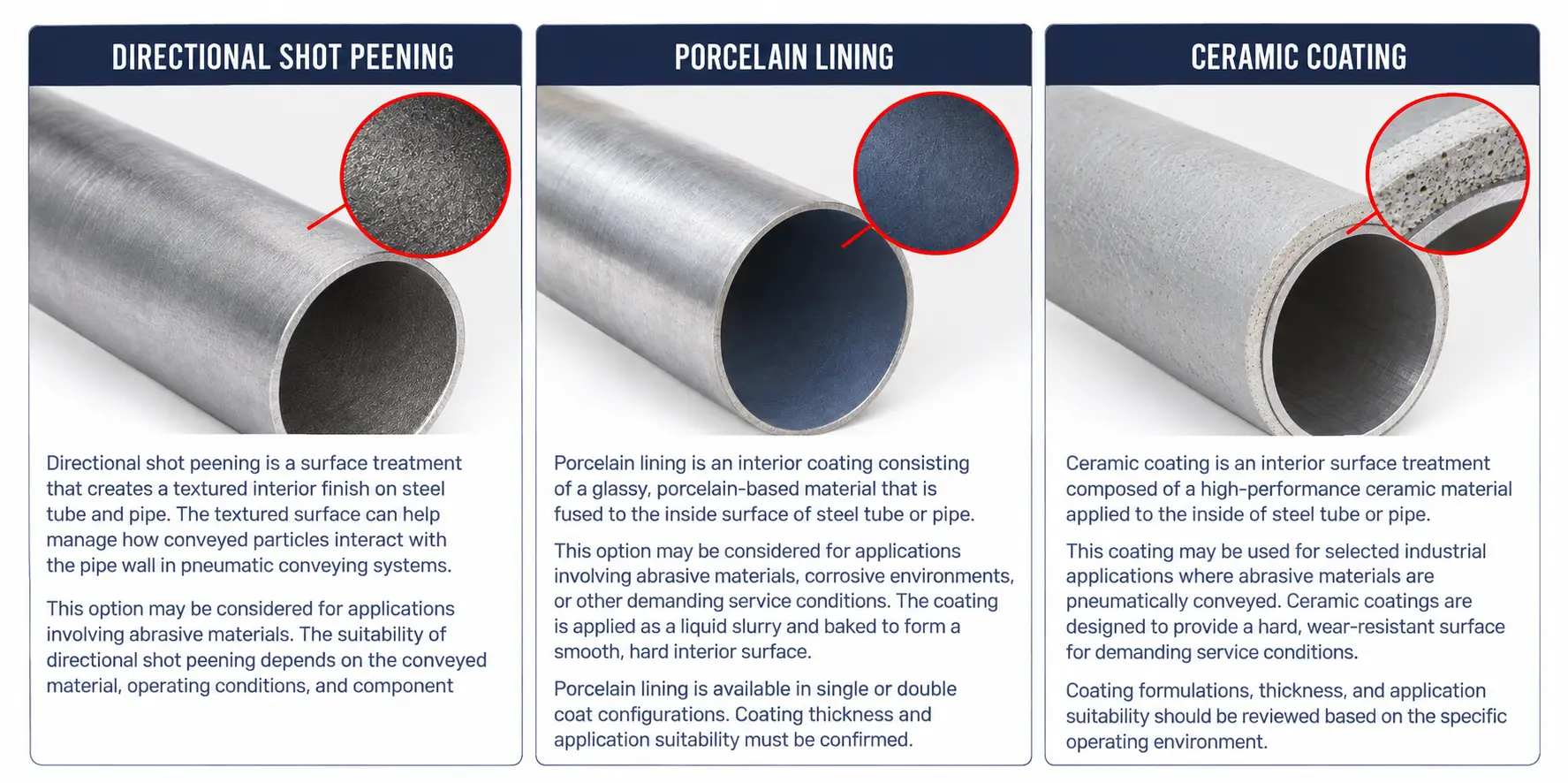
Industrial vacuum and pneumatic conveying systems handling abrasive dust, pellets, granular materials, or bulk solids may experience wear, particularly at elbows, bends, and transitions where particles contact interior piping surfaces. Actual wear patterns depend on particle characteristics, conveying velocity, system design, and operating conditions.
Vacuum-Tubing.com offers specialized options for selected abrasion-related piping applications: directional shot peening, porcelain lining, and ceramic coating. Treatment suitability, component dimensions, and availability are reviewed according to the requested specifications.
Information for Selecting a Treatment
- Conveyed material and particle characteristics
- Tubing outside diameter and wall thickness
- Elbow, bend, or fitting configuration
- Operating conditions and temperature
- Known wear locations and maintenance history
- Requested coating or surface specifications
Important: These are application-dependent product options, not guarantees of component longevity, reduced downtime, or a particular percentage improvement in performance. Availability, compatibility, and manufacturing limitations must be confirmed before ordering.
Need an abrasion-related coating or treatment? Contact Us to discuss your specifications and request a quote.
Fabrication Quality, Welding & Dimensional Verification
Custom piping components must be manufactured to dimensions that allow proper fitment during installation. The required quality controls depend on component design, material, operating conditions, and project specifications.
Dimensional Requirements
- Outside diameter and wall thickness
- Overall length and fitting geometry
- Centerline radius and bend angle
- End preparation
- Specified tolerances
Joining & Fabrication
- Material compatibility
- Specified connection methods
- Weld configuration where applicable
- Assembly clearances and orientation
- Project-specific manufacturing requirements
When Additional Documentation or Testing Is Required
Certain applications may require material documentation, welding qualifications, inspection records, pressure testing, or leak testing. These requirements should be identified during the quotation and specification process.
Applicable codes, acceptance criteria, testing methods, and documentation requirements depend on the system. Any specialized inspection, testing, or certification should be confirmed before an order is placed.
General-purpose industrial vacuum tubing should not automatically be treated as pressure-rated piping. Pressure or high-vacuum requirements must be evaluated separately.
Reducing Total Cost of Ownership (TCO) Through Proper Component Selection
The initial purchase price is only one consideration when comparing industrial piping components. Total Cost of Ownership (TCO) also includes installation costs, maintenance, repairs, replacement frequency, operating requirements, and downtime.
| Cost Factor | What to Evaluate | Potential Benefit of Proper Selection |
|---|---|---|
| Initial Cost | Material, fabrication, freight, and purchasing expenses. | Select specifications appropriate for the actual application. |
| Installation | Fitting alignment, field modifications, labor, and assembly. | Proper dimensions may reduce on-site adjustments. |
| Maintenance | Inspection, cleaning, access, and repairs. | Suitable connections and layouts may improve service accessibility. |
| Replacement | Wear rates and component replacement frequency. | Appropriate materials and fitting geometry may improve component service life. |
| Downtime | Production interruptions, emergency repairs, and delays. | Reliable components and planned maintenance may reduce operational disruptions. |
A Simple TCO Comparison
Consider two piping options with different initial costs. One may cost less to purchase, while the other may require fewer replacements or less installation work over its useful life.
A meaningful comparison should estimate purchase price, installation costs, expected service life, maintenance expenses, downtime exposure, and replacement costs over the same evaluation period.
There is no universal savings percentage or guaranteed lifespan increase. Results depend on the actual system, conveyed materials, operating conditions, and selected components.
Information Needed for a Custom Pipe Fabrication Quote
Providing complete specifications helps evaluate available options, confirm compatibility, and prepare a more accurate quotation.
Component Specifications
- Tubing outside diameter
- Wall thickness or gauge
- Material and grade
- Required quantity
- Overall dimensions
- Connection or end configuration
Bends & Fittings
- Bend angle
- Centerline radius (CLR)
- Tangent lengths
- Main and branch diameters
- Fitting orientation
- Required tolerances
Operating Conditions
- Vacuum or pressure requirements
- Operating temperature
- Conveyed material
- Wear or corrosion concerns
- Environmental exposure
- Applicable project specifications
Supporting Information
- Technical drawings
- Sketches with dimensions
- Existing part numbers
- Photographs of existing components
- Required delivery date
- Inspection or documentation needs
If drawings are unavailable, a detailed sketch with clear measurements and photographs may help us review the requirement.
Related Industrial Vacuum Tubing & Fittings
Explore standard components that may be used alongside custom pipe fabrication requirements.
Frequently Asked Questions About Custom Pipe Fabrication
Can custom vacuum tubing be supplied in nonstandard lengths?
Nonstandard tubing lengths may be reviewed based on material, diameter, quantity, manufacturing limitations, and shipping requirements.
What information is needed for a custom elbow?
Provide the tubing outside diameter, wall thickness, material, bend angle, centerline radius, tangent lengths, end configuration, and required quantity.
Which material is best for pneumatic conveying pipe?
Material selection depends on the conveyed product, operating conditions, wear characteristics, corrosion exposure, and connection requirements. Carbon steel, galvanized steel, stainless steel, and aluminum may be considered where appropriate.
Are custom fittings suitable for pressure applications?
Not automatically. Pressure-rated applications require evaluation of applicable codes, design conditions, materials, joining methods, and testing requirements. These specifications must be identified before quoting.
Can I request fabrication using an existing drawing?
Yes. Customers can submit drawings, specifications, or dimensional sketches for review. Feasibility, materials, manufacturing options, and availability must be confirmed before acceptance.
Need Custom Industrial Vacuum Tubing, Elbows or Pipe Fittings?
Processing Equipment Inc. can assist with reviewing custom piping requirements for industrial vacuum, dust collection, material handling, and pneumatic conveying applications.
Send us your drawings, dimensions, material requirements, quantities, and operating conditions. We can review available options and help determine the next steps for your quotation request.
4 Responses