Long radius elbows, also known as long radius tubing
bends, are commonly used in industrial vacuum,
dust collection, pneumatic conveying, and bulk
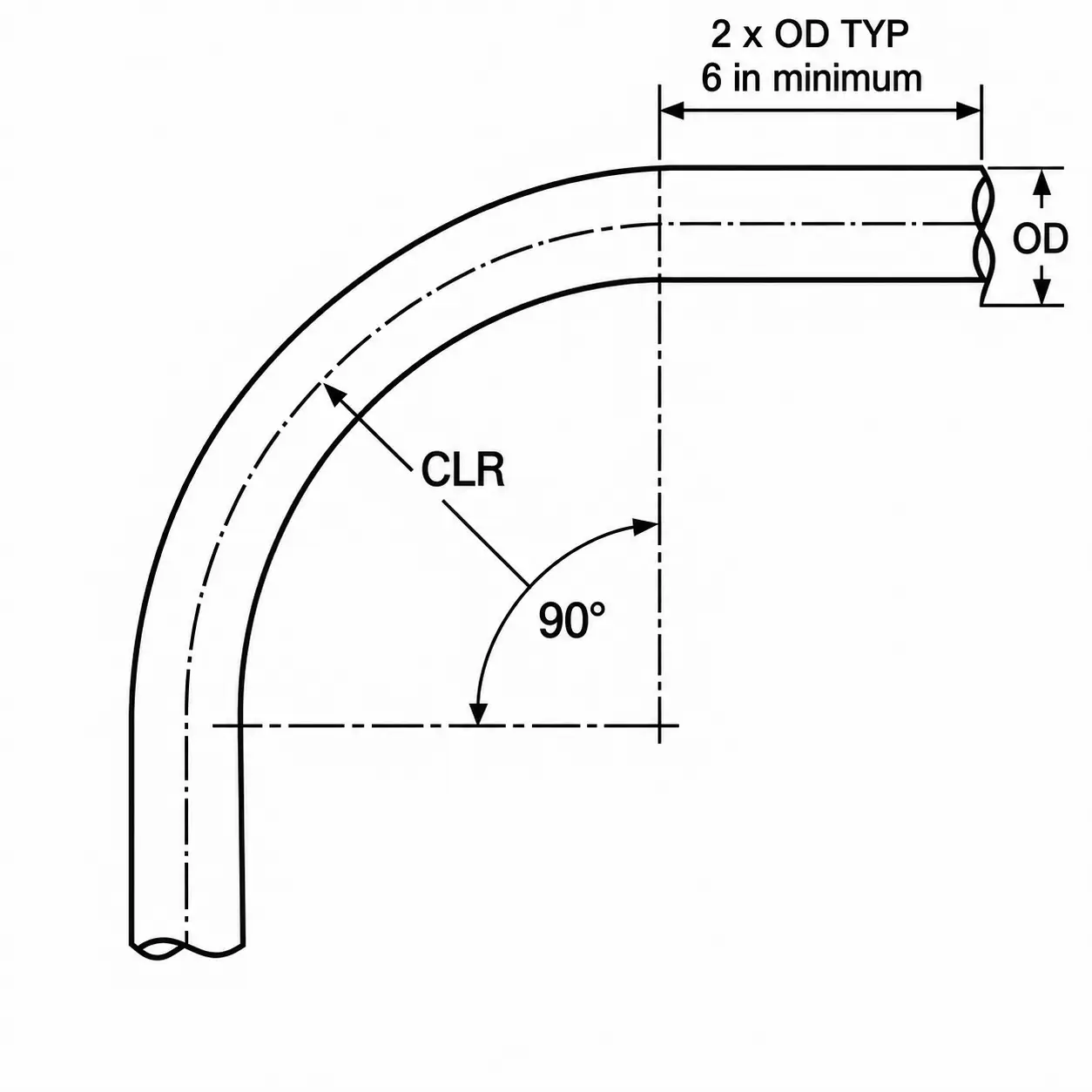
material handling systems. Their extended centerline
radius (CLR) provides a more gradual directional
transition for airflow and conveyed materials
compared with standard or short radius elbows.
Long radius bends are particularly useful in
applications where controlling airflow resistance,
reducing concentrated material impact, and limiting
product degradation are important considerations.
They are available in various tubing diameters,
wall thicknesses, bend angles, and centerline radii
to accommodate specialized industrial installations.
Central Vacuum Systems
Long radius elbows are used in central industrial
vacuum cleaning systems to route tubing between
pickup points, equipment, and central vacuum
producers. Their gradual bend geometry can help
reduce airflow resistance through directional
changes, supporting efficient operation across
extended tubing networks.
Pneumatic Conveying
Long radius bends are widely used in pneumatic
conveying systems transporting powders, pellets,
grains, plastic resins, and other dry bulk
materials. Their larger bend radius provides
a more gradual change in material direction,
which may help reduce localized impact,
product degradation, and pressure loss
in properly designed systems.
Dust Collection
Industrial dust collection systems use long
radius elbows to connect collection piping
between dust-producing machinery and central
dust collectors. Gradual bends can help
maintain airflow through the ducting network
while reducing abrupt directional changes
that may increase resistance or encourage
material accumulation.
Material Handling
Long radius elbows are used in bulk material
transfer systems, railcar unloading,
truck unloading, and industrial processing
operations. These bends help guide conveyed
materials through changes in piping direction
and may reduce concentrated impact compared
with tighter-radius fittings, depending
on operating conditions.
Benefits of Long Radius Tubing Bends
The gradual geometry of long radius tubing bends
provides several potential advantages in industrial
vacuum and pneumatic conveying applications.
Compared with tighter-radius elbows, a properly
selected long radius bend may improve the
transition of airflow and conveyed material
through a change in piping direction.
-
Reduced Airflow Resistance:
A gradual directional change can help reduce
pressure losses in suitable vacuum and
pneumatic conveying systems.
-
Lower Energy Requirements:
Reduced system resistance may help lower
the required blower or vacuum producer
power under appropriate operating conditions.
-
Reduced Material Impact:
A larger bend radius can help limit
concentrated material impacts against
the outside wall of the elbow.
-
Product Protection:
Properly selected long radius bends may
help reduce breakage or degradation of
sensitive pellets, grains, and other
conveyed materials.
-
System Flexibility:
Multiple centerline radius, bend angle,
diameter, wall thickness, and tangent
options accommodate custom piping layouts.
Actual pressure loss, energy consumption,
material wear, and product degradation
depend on conveying velocity, material
characteristics, elbow geometry, and
overall system design.
Long Radius Elbow Materials and Connection Options
Long radius tubing bends can be manufactured
in different material grades and wall
thicknesses depending on the application.
Material selection should account for
corrosion resistance, conveyed material,
abrasion, operating conditions, and
expected service requirements.
Available gauge options vary by tubing
outside diameter. Refer to the long
radius elbow dimensional table above
for available centerline radius and
gauge combinations.
-
Tubing Outside Diameter:
Available sizes and CLR options are
listed in the dimensional table above.
-
End Configuration:
Straight ends only.
-
Connections:
Compatible compression couplings
are commonly used to connect
straight-end tubing bends.
-
Standard Tangent Length:
Two times the tubing outside diameter,
with a minimum length of 5 inches.
-
Custom Tangents:
Available upon request.
-
Centerline Radius:
Multiple CLR options are available
depending on tubing diameter.
-
Bend Angle:
Specify the required bend angle
when requesting a quotation.
Choosing the Correct Long Radius Elbow
When selecting a long radius elbow, confirm
the tubing outside diameter, material,
wall thickness or gauge, bend angle,
centerline radius (CLR), and tangent
length. Proper specification helps
ensure compatibility with the existing
vacuum tubing system and connecting fittings.
For pneumatic conveying applications,
consider the conveyed material, particle
size, abrasiveness, conveying velocity,
pressure requirements, and available
installation space. While longer-radius
bends can reduce abrupt directional
changes, the best bend geometry depends
on the characteristics of the material
and the system operating conditions.
Railcar and Truck Unloading:
Long radius elbows are often used in
pneumatic bulk unloading installations
where material travels from a receiving
hopper or unloading connection through
conveying lines to storage silos,
processing equipment, or receiving vessels.
Bend geometry should be selected to
accommodate the material and system
requirements.
Need assistance specifying a custom
long radius bend?
Contact Us
for help selecting the appropriate
tubing diameter, bend angle, material,
wall thickness, CLR, and tangent length.