Industrial Vacuum Piping: Tubing, Fittings & System Design Guide
Industrial vacuum tubing, fittings, materials, connections, and layout considerations for central vacuum, dust collection, and pneumatic conveying systems.
Industrial Vacuum Piping Systems & Components
Industrial vacuum piping connects pickup points, processing equipment, and collection equipment in a variety of facilities. The tubing, elbows, branch fittings, reducers, and couplings selected for a piping network depend on the material being handled, required airflow, installation layout, and operating conditions.
This guide introduces the components and planning considerations commonly associated with industrial vacuum piping systems used in central vacuum cleaning, dust collection, and pneumatic conveying. It is a general product-selection resource, not a substitute for application-specific engineering.
What Is an Industrial Vacuum Piping System?
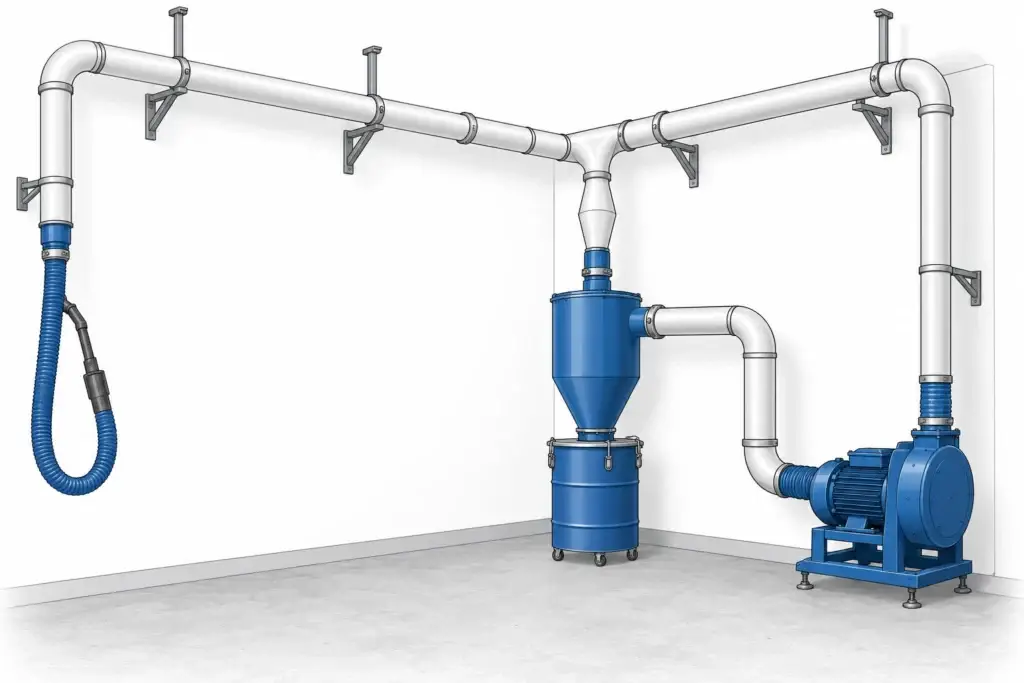
An industrial vacuum piping system is a network of tubing and fittings that provides a flow path between pickup locations and vacuum or collection equipment. Depending on the application, the piping may transport air, dust, chips, powders, or other materials suitable for the system.
Common applications include facility cleanup, centralized material collection, dust extraction, and vacuum-based pneumatic conveying. Different applications require different approaches to tubing diameter, wall thickness, bend geometry, connection style, and maintenance access.
Key Components of Industrial Vacuum Piping
Industrial Vacuum Tubing
Rigid tubing forms the main runs and branch lines in many permanent installations. Tubing selection typically starts with the outside diameter, material, wall thickness, and connection requirements. Depending on the product and size, options may include carbon steel, galvanized steel, aluminum, and stainless steel.
Explore industrial vacuum tubing sizes and materials for available configurations.
Elbows and Bends
Elbows redirect airflow and conveyed material around equipment and structural obstacles. Short-radius, standard-radius, and long-radius designs provide different routing options. A larger centerline radius may be useful where a more gradual turn is desirable, but the correct selection depends on layout, available space, material characteristics, and operating conditions.
See industrial vacuum elbows and bends for fitting styles and related product information.
Branch Fittings
Branch fittings connect multiple pickup points or tubing runs into a network. TY, YL, double-branch, and other configurations can be selected according to the main-line diameter, branch diameter, connection geometry, and proposed routing.
Review industrial vacuum branch fittings for common configurations.
Reducers and Adapters
Reducers transition between different tubing diameters. Male and female adapters help connect tubing to fittings or equipment with different end configurations. Confirm the actual dimensions and end styles rather than relying on nominal size alone.
Browse vacuum pipe reducers and vacuum pipe adapters.
Compression Couplings and Other Connections
Couplings join tubing sections and may also simplify disassembly for changes or maintenance. Compression couplings, slip couplings, and other joining methods have different installation requirements. Selection should account for tube outside diameter, material, alignment, and the intended system conditions.
See industrial vacuum compression couplings for joining options.
Choosing Materials for Vacuum Tubing
Material choice should reflect the environment, transported media, mechanical requirements, and compatibility with adjoining components. The following table describes general considerations rather than approvals for a particular process.
| Tubing Material | Selection Considerations | Potential Applications |
|---|---|---|
| Carbon Steel | Strength, wall thickness, wear conditions, and surface protection | General industrial vacuum and material transport piping |
| Galvanized Steel | Steel tubing with a zinc coating; suitability depends on exposure and service conditions | Facility vacuum and selected dust collection installations |
| Aluminum | Lower weight; consider abrasion, mechanical loading, and process requirements | Selected central vacuum and conveying layouts |
| Stainless Steel | Corrosion resistance varies by alloy and process environment | Installations where corrosion resistance or material compatibility is important |
Confirm material grades, dimensions, and product availability for the specific tubing or fitting before ordering. A material name alone does not establish suitability for sanitary service, combustible dust, corrosive chemicals, or a particular pressure or vacuum rating.
Industrial Vacuum Piping Design Considerations
Diameter and Airflow Requirements
The tubing diameter must be considered together with the airflow available from the vacuum equipment, the number of operating pickup points, piping length, and the material being conveyed. Undersized or poorly configured runs can create excessive resistance; oversized piping can also be unsuitable for some conveying applications. A qualified system designer should determine the operating requirements.
Elbow Radius and Routing
Every change in direction affects the flow path. When comparing short-, standard-, and long-radius elbows, consider space limitations, the number of bends, service access, and whether solids will move through the line. Avoid unnecessary turns where practical, and select elbows based on the application's requirements rather than assuming one radius is best for every system.
Connections and Leakage
Correctly matched tubing ends, fittings, couplings, and seals are important to assembly and system performance. Verify component compatibility and follow the applicable installation instructions. Inspect connections when equipment performance changes or when a line has been reconfigured.
Material Accumulation and Maintenance Access
For dust, chips, or bulk material handling, consider the risk of buildup at bends, transitions, and low points. Equipment layout should allow practical inspection and cleaning. Operating airflow and conveying velocity are application-specific; a universal target should not be assumed.
Safety and Process Compatibility
Combustible dust, hazardous materials, high temperatures, and specialized processing conditions may require additional design measures and equipment. Grounding, bonding, explosion protection, material compatibility, and code requirements must be evaluated for the actual installation by qualified personnel. Standard product descriptions should not be interpreted as safety certifications.
Installation and Inspection Considerations
- Confirm dimensions: Check tubing outside diameter, wall thickness, fitting ends, and coupling compatibility before assembly.
- Plan supports: Support long runs and fittings according to the installed loads, layout, and applicable design requirements.
- Inspect before assembly: Check for shipping damage, debris, misalignment, and damaged connection surfaces.
- Provide access: Make allowances for inspection and maintenance in areas where material may collect.
- Verify the installed system: Follow the system manufacturer's commissioning procedures and applicable safety practices before operation.
Frequently Asked Questions About Industrial Vacuum Piping
What is the difference between vacuum tubing and vacuum hose?
Rigid tubing is commonly used for fixed piping runs. Flexible hose is typically selected where movement, equipment connection, or access requires flexibility. Hose suitability depends on its construction and the operating conditions.
Which materials are available for industrial vacuum tubing?
Depending on size and product type, options may include carbon steel, galvanized steel, aluminum, and stainless steel. Confirm current availability and dimensions before ordering.
Are long-radius elbows always required?
No. Short-, standard-, and long-radius elbows are used for different layout and flow requirements. The application determines the appropriate configuration.
How do I choose a compression coupling?
Start with the tubing outside diameter, end configuration, material, and operating conditions. Check the coupling specifications for compatibility and installation requirements.
Need Industrial Vacuum Tubing, Elbows or Pipe Fittings?
Vacuum-Tubing.com, operated by Processing Equipment Inc., provides information on tubing, elbows, branch fittings, reducers, adapters, and couplings for industrial vacuum, dust collection, material handling, and pneumatic conveying applications.
Send us your tubing outside diameter, dimensions, material, connection details, quantities, and operating conditions so we can review your product requirements and available options.