
The Ultimate Guide to Selecting an Industrial Vacuum Tubing Supplier: Reducing TCO, Zero Downtime, and Ensuring ISO-Certified Quality
Introduction: Why Your Vacuum System is a Strategic Investment
An efficient industrial vacuum piping system is more than just a convenience; it is a critical infrastructure for modern manufacturing, safety, and maintaining regulated industrial environments. Sectors ranging from pharmaceuticals and food processing to heavy industrial manufacturing rely on efficient vacuum piping systems to properly convey materials, ensure clean air quality, and maintain precise processing pressures.
The decision to purchase vacuum tubing is a major strategic choice. A poorly designed system using low-quality components can lead to massive energy waste, reduced productivity, and unexpected equipment failure. These risks can be far more expensive than the project’s initial outlay. Therefore, it is essential to ensure maximum quality standards, customization flexibility, and logistical reliability when choosing a supplier.
This article outlines the strategic partner selection criteria for B2B buyers, guaranteeing not just a product, but long-term functionality and a significant reduction in the Total Cost of Ownership (TCO).
1. Material Science and the Excellence of Heavy-Duty Design
The performance of an industrial vacuum system hinges on the quality of its physical components. The correct choice of tubing and fittings maximizes efficiency by minimizing pressure drop and preventing leaks.
1.1. Selecting the Right Material for Industrial Applications
A one-size-fits-all solution is inadequate for industrial vacuum tubing. Different industries require unique solutions:
- Stainless Steel: Unrivaled in corrosion resistance. Used where process contamination or maintaining high purity (e.g., food, pharma) is essential. Its long lifespan and minimal maintenance play a vital role in reducing TCO.
- Aluminum and Galvanized Steel: Suitable for lightweight conveyance and cost-effective solutions, providing structural strength for general manufacturing or central vacuum systems.
The chosen tubing must possess critical characteristics such as flexibility, crush resistance, abrasion resistance, and application-specific chemical resistance.
1.2. Optimizing Performance Through Component Quality
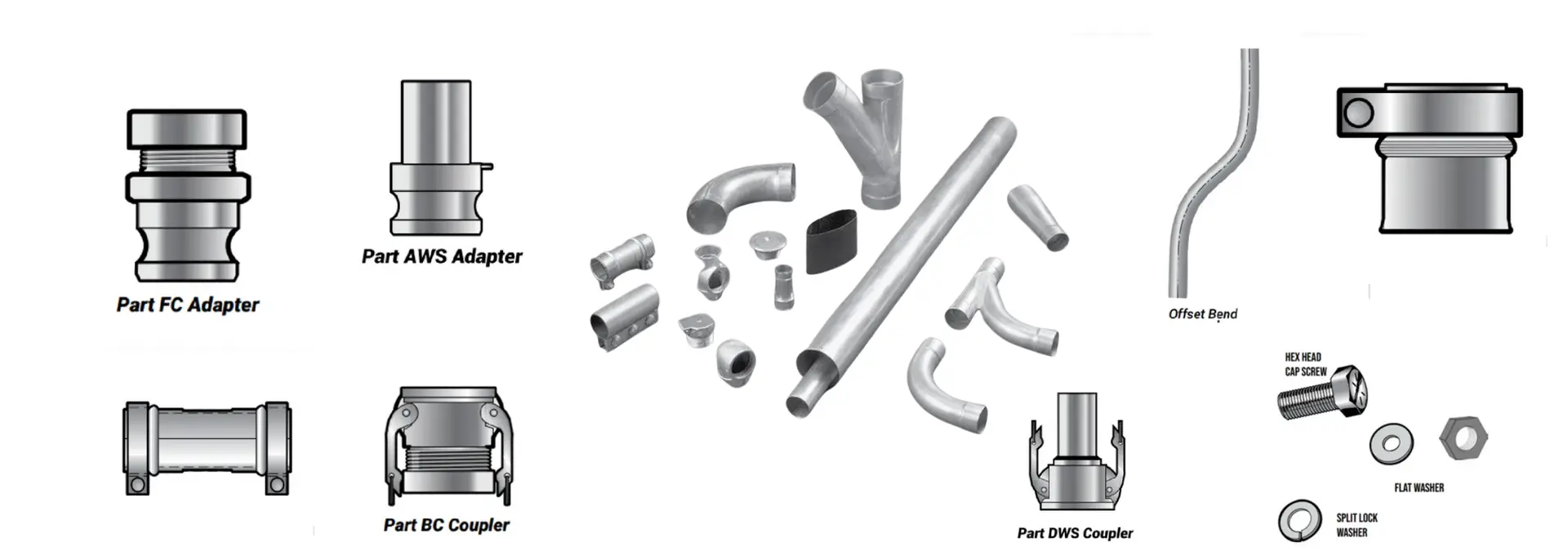
A complete vacuum system includes valves, reducers, adapters, and various types of couplings. The design of these auxiliary components dictates the system’s overall efficiency.
- Long Radius Elbows: Crucial for reducing pressure loss and friction. They ensure smoother material flow, lowering energy consumption and reducing material buildup inside the piping.
- Couplings and Fittings: Compression couplings (Morris-type) and other adapters must ensure a perfect seal. High-quality couplings guarantee a tight seal (preventing energy-wasting leaks) and ease of maintenance.
A supplier who invests in heavy-duty, corrosion-resistant designs provides a solution that reduces operating costs. This makes the purchase an investment that reduces TCO in the long run.
Material | Primary Application Focus | Corrosion Resistance | Abrasion Resistance | Impact on TCO |
Stainless Steel | Food, Pharmaceuticals, High-Vacuum | Excellent | High | Long lifespan, minimal maintenance |
Aluminum | Central Vacuum, Light Material Conveying | Good | Medium-High | Ease of installation, lower labor cost |
Galvanized Steel | General Manufacturing, Dust Extraction | Moderate | High | Cost-effective and high structural strength |
2. Unyielding Quality Assurance: ISO Compliance and Material Traceability
B2B purchasing decisions are driven by data, reliability, and risk management. Procurement managers select suppliers based on product quality, adherence to industry standards, established reputation, and comprehensive technical support.
2.1. ISO 9001:2015: Proof of Process Excellence
ISO 9001:2015 is an internationally recognized standard for Quality Management Systems. A supplier’s certification proves that their internal processes are subject to rigorous and consistent quality control, ensuring products consistently meet specified requirements from design through delivery.
ISO 9001 is not merely a symbol; it is an assurance that minimizes operational risk for buyers.
2.2. Material Traceability: Guaranteeing Accountability
Product traceability acts as an indispensable ‘safety net’. It refers to the ability to track the movement and history of a product from its origin (raw materials) to the final customer.
A leading supplier ensures all materials, particularly critical components like stainless steel, meet specific standards. If a component fails, the source of the defect can be quickly identified. This capability:
- Prevents the spread of the same issue to other batches.
- Minimizes the risk of widespread production shutdowns or product recalls.
This is paramount for B2B buyers in terms of legal liability and operational risk management.
3. Eliminating Hidden Flaws: The Role of Non-Destructive Testing (NDT)
Industrial vacuum tubing, especially for heavy-duty applications, requires quality assurance that goes beyond visual inspection. Non-Destructive Testing (NDT) is the essential method used to identify internal flaws, inconsistencies, or weaknesses without causing any damage.
3.1. Essential NDT Methods a Supplier Should Utilize
A quality-driven supplier uses specific NDT methods to prove structural integrity:
- Ultrasonic Testing (UT): Uses high-frequency sound waves to detect internal cracks, voids, or defects, particularly in inspecting thick tubing or welded joints. This ensures the tube’s structure will remain intact under pressure.
- Magnetic Particle Testing (MPT): Effective for detecting surface and near-surface defects in ferromagnetic materials (e.g., steel). Helps identify minute cracks in weld lines that could increase corrosion risk.
- Liquid Penetrant Testing (LPT): Used to detect surface-breaking cracks on non-porous materials (stainless steel, aluminum). Crucial for maintaining a leak-free environment in vacuum systems.
NDT Method | Focus of Detection | Benefit for B2B Buyer | Risk Mitigation Strategy |
Ultrasonic Testing (UT) | Internal cracks and weld flaws | Guarantee of structural integrity | Avoid downtime due to internal failure |
Magnetic Particle Testing (MPT) | Surface and near-surface defects | Quick fault correction, increased corrosion resistance | Ensuring long-term durability |
Liquid Penetrant Testing (LPT) | Surface-breaking cracks | Guaranteeing a leak-free system | Preventing process contamination and premature system failure |
Transparent NDT practices prove to B2B engineering teams that every component meets the strictest industry standards, significantly reducing the buyer’s risk of unexpected failures.
4. Strategic Logistics: Rapid Delivery Through Supply Chain Flexibility
In industrial environments, time is money. Waiting for an essential component means inevitable downtime and substantial financial loss. Therefore, a supplier’s logistical excellence and supply chain flexibility are major competitive advantages.
4.1. Lead Time Management and Rush Service
While standard lead times can be long (six to eight weeks), urgent repair needs arise constantly. An effective supplier offers ‘rush service’ or priority delivery outside of standard times. Maintaining frequent roll schedules also allows for greater flexibility for custom orders and reduces overall lead times.
4.2. Reducing Stockouts Through Advanced Inventory Control
A leading supplier maintains sufficient buffer stock for standard components (couplings, reducers, elbows) and ensures the rapid supply of these materials alongside complex custom orders.
When a supplier efficiently manages inventory using advanced software (barcodes/RFID), they protect the buyer’s capital. This allows the buyer to lower their inventory levels and maintain Just-In-Time (JIT) operations, essential for modern manufacturing.
4.3. Value Addition Through Customer Service
Responsive customer service is a significant part of long-term value. For technical questions, defects, or delivery issues, you need a partner who is easy to contact and quick to resolve problems. Comprehensive technical support and after-sales service are indispensable for a successful B2B partnership.
5. From Customization to Partnership: Meeting Your Unique Needs
The final purchasing decision favors a platform that provides solutions that perfectly fit unique industrial processes, not just high-quality components.
5.1. Custom Design: Not One-Size-Fits-All
Every vacuum system is unique. Customization ensures that the piping system operates at maximum efficiency. A customized design (e.g., unique diameter, highly abrasion-resistant inner coating) increases the system’s lifespan and reduces maintenance costs, further lowering the TCO.
5.2. Streamlining Procurement (The ‘One-Stop Solution’)
Sourcing all system components (tubing, valves, adapters, reducers, couplings) from a single supplier reduces purchasing complexity and logistical risk. Buyers expect an extensive product catalog and supporting resources to select the correct components for complex applications.
Final Call to Action: Why Choose Vacuum Tubing Solutions?
Selecting an industrial vacuum tubing supplier determines the reliability, safety, and overall efficiency of your industrial processes. Choosing Vacuum Tubing Solutions means investing in high-quality components and an unparalleled supply chain.
We provide robust, heavy-duty, and corrosion-resistant stainless steel and aluminum tubing. Our quality assurance includes:
- ISO 9001 Certification
- Complete Material Traceability
- Advanced NDT Practices (UT, MPT, LPT)
Operational efficiency is maintained through fast lead times, customization flexibility, and responsive customer service. This combination ensures a promise of long-term TCO reduction and zero downtime.
Summary of the Article’s Conclusion
Selecting a supplier is a long-term strategic partnership decision. Avoid cheap alternatives that lead to hidden costs and risks. Choose a partner who offers verifiable quality (ISO 9001 & NDT), complete material traceability, and unparalleled logistical expertise.
Vacuum Tubing Solutions is not just a supplier—it is a strategic investment to ensure the reliability and effectiveness of your industrial processes.
To lay the foundation for your productivity through our heavy-duty, custom-designed solutions and unparalleled supply chain, contact us to discuss your project requirements.
Most recent post
Precision Engineering Fabrication: Reducing Total Cost of Ownership (TCO) in Custom Vacuum and Heavy-Duty Pneumatic Piping Systems
Precision Engineering Fabrication: Reducing Total Cost of Ownership (TCO) in Custom Vacuum and Heavy-Duty
The Perfect Solution for Your Industrial System: The Complete Guide to Buying High-Performance Vacuum Fittings and Adapters
The Perfect Solution for Your Industrial System: The Complete Guide to Buying High-Performance Vacuum
The Ultimate Guide to Selecting an Industrial Vacuum Tubing Supplier: Reducing TCO, Zero Downtime, and Ensuring ISO-Certified Quality
The Ultimate Guide to Selecting an Industrial Vacuum Tubing Supplier: Reducing TCO, Zero Downtime,